




Boogiepop Phantom
Oshimeter
Synopsis
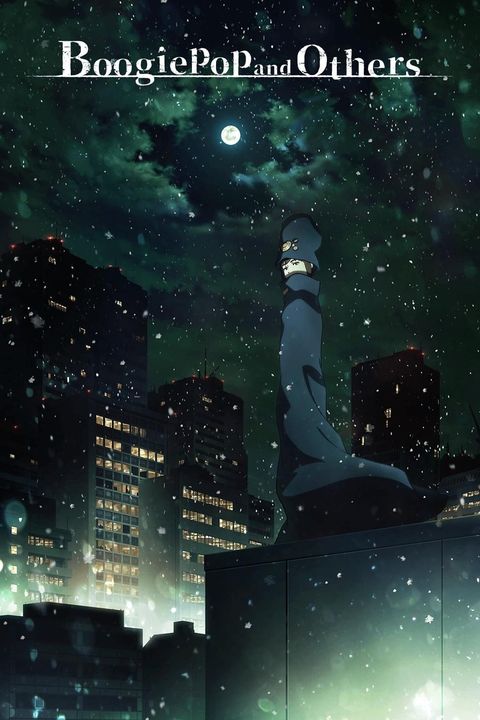
Boogiepop, a rumored shinigami, is said to lurk where they cannot be seen. Five years ago, a string of gruesome murders shocked the populace, and students attributed some of those killings to the aforementioned death god. When mysterious happenings once again affect the lives of those attending Hijiridani High School and Shinyo Academy, whispers of the enigmatic Boogiepop are resurrected. The stories being told may contain partial truths, or perhaps the world as humans know it is more dangerous than previously believed.
Episode Guide
Characters
Boogiepop
Boogiepop, a mysterious, gender-ambiguous shinigami, appears to combat supernatural threats, acting mechanically and speaking archaically.
Rabbai Debora
Nagi Kirima
Gifted and dangerous, Nagi Kirima, the Fire Witch, investigates supernatural events, driven by a messianic complex and past trauma.
Lillis Rachael
Touka Miyashita
Outspoken and helpful, Touka guides friends, though sometimes appearing indifferent.
Rabbai Debora
Boogiepop Phantom
Boogiepop Phantom, a successor born from light, honors its predecessor's legacy.
Grant Simone
Kazuko Suema
A criminally-minded student, Kazuko investigates supernatural events after a near-fatal encounter with a serial killer.
Benkovitz Anne
Community Feed
Loading…

The anime is a lot like the novels story wise, although arguably more creepy. Each episode of Boogiepop Phantom focuses on a different character and there perspective on what’s going on in the story. Sometimes it could just be one’s perspective, two, or maybe even three! Well it mostly sticks around two or less. Because of this each episode at first can feel disconnected if you aren’t paying attention, especially during episodes 5 to 8. However, as the story goes along everything makes sense. We as the audience figure out the major threat as to why all this strays nonsense is happening. Why a girl can see her dead best friend, why everyone is getting strange powers, why they are a danger to the world. It’s all explained in a really well way even if it can still be a tad confusing, but not as confusing as Serial Experiments Lain I would argue. Some of my favorite parts of the story is how each character is explored, but we’ll get to that when I talk about the characters. The atmosphere really helps with this too. The anime is given a dark colour pallet that makes everything feel odd and unreal. I really enjoy the way the anime is colored looks and sounds because I’ve never seen an anime with such an effective sound design other than maybe Perfect Blue or Shiki, but even the I feel this anime overwhelms it with its spooky sound design. It’s just so odd and creepy even. The soundtrack I feel was really good too. It really fit the vibe of the show and the odd feeling it gave off. It’s even more interesting since seemingly some of the music was stock music that was changed slightly, but you would never be able to tell with how well it fits the show. As I’m writing this I’m even listening to the soundtrack right now! Now I love the characters of this show. On the surface they could at first appear bland. They mostly have bland designs that represent them being people. No colorful hair, expressive tones, nothing of the sort. I like that because it makes them feel more real. They all feel like real people and I just love that about them. There is Boogiepop, well, two Boogiepops. One is the separate identify of Touka Miyashita while the other absorbed with Manticore during her death. None of that may make sense but if you read the first book and watch the anime, you may get it better. Then there is Nagi Kirima and Kazuko Suema from the first book and seemingly other books. There is even Poom Poom who is in a book! Now for the characters made for the show, my favorite are Manama Kisaragi, Misuzu Arito, Moto Tonomura, Saki Yoshizawa, Yoji Suganuma. Manama is the main villain of the show who does many stuff wrong, but not any fault of her own. She was a sheltered girl due to powers she had, seemingly able to collect memories which took the shape of memories. After being killed by her grandmother, she is revived due to a flash of light, which was an event that happened in the first book, that causes a part of Echoes life source to absorb into her. I know that sounds confusing but just go with it. Then her grandma passes of old age and she leaves her house, exploring the outside world and just wanting to have friends. For Moto she is one of the few characters who is hinted to have lived, although still doesn’t get her happy ending. She is still depressed, heart broken her crush is dead, and that’s all we hear from her. Yoji is very similar although he feels more deserved. He ends up getting hooked to a dating sim to the point he confuses the fictional character on said dating sim and his coworker Rie together. It doesn’t help he is also hooked on a drug called Type S. Eventually he has a mental breakdown after his computer seemingly shuts down permanently and his fate is left ambiguous. Now for my few cons, the story is very hard to understand if you have not read any of the books. You specifically have to read the first and sixth books if you want to understand any of the anime. Or you could watch the live action adaptation of the first book but I don’t recommend that. Because of this if you go in blind expect to be totally confused. The animation can be very rough at times to a point it can be considered funny. It’s a tad shocking since the studio behind it was Madhouse, which is an anime studio known for being well advanced in the animation side. It’s not the worst animation in the world but it can appear rather janky, which may worsen the experience. And that’s my review! The anime is phenomenal even with its flaws and I heavily recommend it. It’s worth it, trust me. {Pros} - The story is really well executed - Atmosphere is creepy in a unsettling and dreamlike way - I adore the soundtrack - The characters are very interesting and well written {Cons} - You would have to read the first and sixth book to understand parts of the anime more - The animation can be very rough at certain points Personal Rating - 8.4/10 IMDB Rating - 7.2/10 MAL Rating - 7.1/10

Un episodio de cierre que no explica realmente todo lo que ocurrió, sino que sirve como un epilogo de los eventos y en donde los personajes pueden seguir adelante con sus vidas. Además de cerrar el misterio alrededor de Ichiro Kishida. No es un final completamente claro, pero sirve para este anime en particular. Un anime que durante todos los episodios se expresó a través de símbolos e ideas. No es un anime para todo el mundo, no se lo recomendaría a alguien que prefiere explicaciones directas y una narración lineal y efectiva de la trama. Pero sirve como anime de nicho y de culto que trata temas filosóficos e existenciales acerca de la memoria y la nostalgia.
Un episodio muy revelador que conecta varios puntos de episodios anteriores y en donde por fin nos explican el trasfondo Manaka, dándonos contexto sobre su origen y poderes. El episodio tiene un cierre emocional para el personaje, aunque no es nada sencillo entender el cómo se narra porque sigue mostrándose de modo abstracto y simbólico.

A confusing ending to a confusing experience. This episode felt incredibly mundane and anticlimactic for a finale. It was a total change of pace, with a sense of having missed something, even at the end. Perhaps better on a rewatch, but certainly not a show for most people.
This episode provided insight into Echoes, showing how and why she ended up the way she did. The episodes are becoming more coherent with time, but the number of unanswered questions is dwindling only slightly. With only one episode left, some things may just remain a mystery.
This episode included a lot of philosophical dialogue, with most of it being a back and forth between Poom Poom and Boogiepop Phantom. Possibly the best and most coherent of the episodes so far, with clear indication of the topics at hand.
Every episode of this show has an almost fever-dream-like quality to it. Disjointed stories vaguely connected through recurring characters or moments. It has gotten less jarring and confusing over time, but will certainly not be worth watching for most people even so.

I love that the final episode was so much brighter in tone (literally and figuratively), it makes the previous episodes feel even more like a dream in retrospect. The ending felt bittersweet yet hopeful. Look, I'm not going to pretend I knew exactly what was happening in this anime the whole time, but it was a lot more comprehensible than I've seen others say it is. It took a surrealist, unconventional approach to story-telling. If you prefer a straightforward story where everything is laid out clearly, this might not be the anime for you. If you want to watch something different, give it a shot.
This episode was beautiful, yet heartbreaking. Manaka is such a tragic character. This anime touches on so many different issues and experiences that many people can relate to, expressing them in such creative ways.
I wasn't expecting this to be a continuation of the story from the previous episode. The amusement park at night made for a great spooky setting. I also found the scene at the beginning of the episode showing Poom Poom "making friends" very beautiful, despite how dark it is.
This episode has been the most coherent by far, with multiple connections made between previous episodes and the main plot surrounding Boogiepop Phantom. It is, however, still borderline nonsensical. This series feels more like a puzzle to solve than entertainment.
Another episode I found deeply sad. It touches on losing your youth and with it all of your dreams and ambitions. Unfortunately, growing up is inevitable and there's no benefit to remaining stuck in your childhood.
Un episodio que continúa temáticamente como el anterior, pero además le agrega un toque de horror. De la misma manera, la forma que tiene de contar las cosas es abstracta y no se centra tanto en un caso individual sino en una idea general.
Un episodio que se centra en varios personajes y abarca el significado de crecer y la nostalgia, desde un punto de vista trágico. Es impactante emocionalmente sobre todo por el final de uno de los personajes, pero nuevamente se expresa a través de simbolismos, lo que puede hacerlo confuso.
Un episodio centrado en el personaje de Nagi, su desarrollo y trasfondo de por qué es como es y piensa lo que piensa. También es más filosófico y lo más interesante está en las conversaciones e ideas, pero también por ello mismo es abstracto y en ocasiones confuso. No es tan impactante ni emocional como episodios anteriores, pero logra exponer los temas filosóficos y existenciales de este anime.
This episode was deeply unsettling, but again appeared not to serve the overall plot much. Perhaps some people may not mind the lack of explanation or coherent plot, but the constant confusion can be extremely grating if you do mind.
Another episode that is confusing when taken as a part of the whole, but somewhat stands up alone. Perhaps the enjoyment of it is tainted by the expectation that it make any sense. Not unentertaining, but it does nothing to help the lack of plot coherence.
This is by far the most conventional and easy to follow episode we've gotten thus far. We learn more about Nagi, Boogiepop and the Manticore. However, it also leaves me with a lot more questions.
I really can't praise the score/soundtrack enough. This episode in particular has such a surreal and dreamlike atmosphere. I definitely recommend watching with headphones to fully immerse yourself.
This episode might seem like it's not really tied to the main story, but to me it works at showing the effects of what's happening in this world on people that aren't directly involved. While still having that creepy atmosphere, I left this episode feeling sad instead of unsettled.
Boogiepop Phantom
 10
10More DetailsRadar5
Choose what you want to review:
a single episode or the full anime.


