





FLCL
Oshimeter
Synopsis
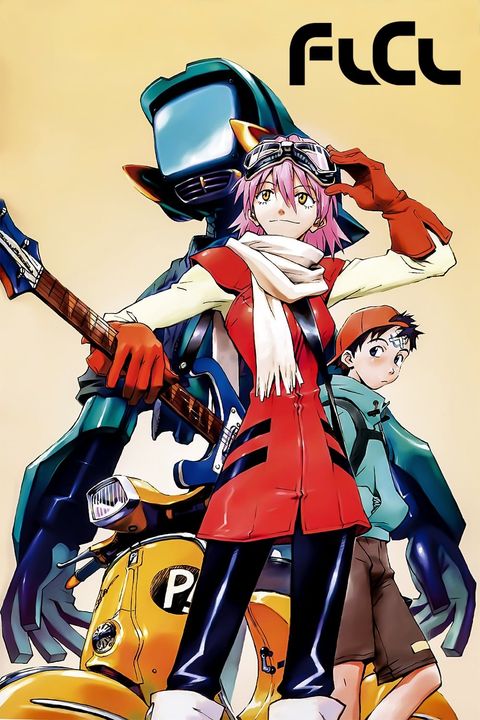
Naota is a completely bored twelve-year-old in a nothing town until a woman on a Vespa hits him in the head with a bass guitar. Then robots start growing out of his forehead. Welcome to FLCL. The woman is Haruko, chaotic, unpredictable, and suddenly living in Naota's house for reasons that make zero sense at first. His life was already awkward enough, dealing with his older brother's ex-girlfriend still hanging around and clinging to him like a replacement. Now there are mechs erupting from his skull and a guitar-swinging maniac treating his head like a portal. FLCL is only six episodes, and it spends most of that time being genuinely weird on purpose: shifting animation styles mid-scene, never stopping to fully explain itself, letting the rock soundtrack from The Pillows carry the emotional weight when the visuals go abstract. It's a coming-of-age story underneath all the chaos, about a kid who hasn't figured out who he is yet, told through the lens of surreal sci-fi comedy. If you liked the psychological messiness of Neon Genesis Evangelion or the kinetic energy of Gurren Lagann, FLCL sits somewhere between both while being unlike either. It's not a long commitment, and it rewards paying attention. The kind of thing you finish and immediately want to rewatch because you know you missed something.
Episode Guide
Characters
Haruko Haruhara
Energetic alien bassist Haruko Haruhara catalyzes FLCL's plot with her guitar and Vespa, leaving chaos in her wake.
Wahlgren Kari
Mamimi Samejima
A troubled teen, Mamimi is a pyromaniac smoker who uses Naota as a Tasuku substitute, exhibiting self-destructive tendencies and clinging behavior.
Sheh Stephanie
Naota Nandaba
A 12-year-old boy obsessed with maturity, Naota is thrust into surreal events, grappling with adolescence and his feelings for Haruko.
Goodson Barbara
Community Feed
Loading…

Probably the best post modern coming of age story ever animated.

I don't fully get it and honestly that's kind of the point First, a disclaimer, I am not a sci-fi person. At all. Giant robots, space stuff, weird science things happening for no clear reason that is genuinely not my thing, and FLCL has ALL of that. Like a lot of it. There are robots coming out of a kid's head. Literal robots. Out of his forehead. And somehow that's not even the strangest part of the show. So if you're like me and you see "mecha" in the tags and your eyes glaze over a little, just know that feeling does not go away. I pushed through it, and I'm glad I did, but I won't pretend it was comfortable watching. The plot. Oh, the plot. Here's the thing I spent a good chunk of the first two episodes genuinely wondering if I had missed something. Like did I skip an episode? Did my brain just stop working? The story follows this twelve-year-old boy named Naota who lives in this weirdly flat, quiet town, and then a completely unhinged woman on a Vespa shows up and hits him with her bass guitar, and his life falls apart in the most chaotic way possible. There's a corporation, there's an iron, there's a hand coming out of the TV, there's, I don't know, a lot. The plot is genuinely confusing, and I want to be honest that it IS intentional. The show is not broken. It is doing this on purpose. It's using all the chaos and the "what is even happening?" energy to mirror what being twelve and completely overwhelmed by the world actually feels like. Growing up, first feelings for someone, your body changing, adults not making sense FLCL turns all of that into literal robots and guitar smashing, and somehow it works. Once I understood that the confusion WAS the metaphor, I relaxed a little. And speaking of metaphors, this show is stuffed with them. Naota's head is literally a gateway things grow out of him against his will, and he can't control what comes out of him. A strange older woman shows up and disrupts everything comfortable and safe. I mean. Come on. That is puberty. That is adolescence wrapped in the most insane visual language I've ever seen, but it's THERE, and it's actually kind of beautiful once you see it. The whole show is basically one long metaphor for growing up and the loss of innocence and the moment you realize the world is bigger and stranger and more painful than you thought. It's doing real thematic work underneath all the nonsense. I respect that a lot even when I didn't enjoy the surface-level stuff. The animation, though. Genuinely, the animation is something else. I kept stopping and just staring at certain scenes. The way it shifts styles sometimes it goes full manga panels right in the middle of a sequence, sometimes it turns almost sketch-like, and sometimes it's doing something so fluid and kinetic you can't believe it's from 2000. The action scenes especially are just electric. There's an energy to the movement that most anime don't have even now with bigger budgets and better technology. It feels alive in a way that's really hard to describe. The people behind this clearly had complete creative freedom and used every single pixel of it. I genuinely cannot imagine what it was like to watch this when it came out. 2000. People sitting down for this with no context, no internet explainers, and no YouTube explained videos about what it all means. That must have been a completely disorienting experience, and I mean that as a compliment. Even now in 2026, with all the weird experimental anime that exists, FLCL still feels unlike anything else. It is still better than probably 80% of what gets made. The ambition alone puts it above most things. The fact that it committed so fully to its own strange vision without apologizing for it is rare. The soundtrack is apparently a big deal, and I get why. It has this raw rocky energy that just fits the show perfectly. Honest disclaimer though, I only started watching anime in May 2023, so I don't have that nostalgic attachment to these songs that long-time fans seem to have. I see people talking about this music like it's tied to core memories, and I'm just not there. I came in completely fresh. Even so, I genuinely liked it, it never feels like background noise it feels like it's actually part of what the show is saying. I can only imagine how much harder it hits if you grew up with it. Here's my honest conclusion, though. It's too weird for me personally. That is completely on me, I know that. My taste runs toward things that are a little more grounded, a little more emotionally straightforward. FLCL demands you meet it on its own terms, and I'm not sure I was fully able to do that. But I cannot in good conscience ignore what it is. It's revolutionary. It changed what people thought anime could do. It took a six-episode runtime and packed more genuine ideas and visual invention into it than most shows do in two cours. So. 7/10. Because I couldn't love it the way it deserves to be loved, but I absolutely know it deserves to be loved.

I don't fully get it and honestly that's kind of the point First, a disclaimer, I am not a sci-fi person. At all. Giant robots, space stuff, weird science things happening for no clear reason that is genuinely not my thing, and FLCL has ALL of that. Like a lot of it. There are robots coming out of a kid's head. Literal robots. Out of his forehead. And somehow that's not even the strangest part of the show. So if you're like me and you see "mecha" in the tags and your eyes glaze over a little, just know that feeling does not go away. I pushed through it, and I'm glad I did, but I won't pretend it was comfortable watching. The plot. Oh, the plot. Here's the thing I spent a good chunk of the first two episodes genuinely wondering if I had missed something. Like did I skip an episode? Did my brain just stop working? The story follows this twelve-year-old boy named Naota who lives in this weirdly flat, quiet town, and then a completely unhinged woman on a Vespa shows up and hits him with her bass guitar, and his life falls apart in the most chaotic way possible. There's a corporation, there's an iron, there's a hand coming out of the TV, there's, I don't know, a lot. The plot is genuinely confusing, and I want to be honest that it IS intentional. The show is not broken. It is doing this on purpose. It's using all the chaos and the "what is even happening?" energy to mirror what being twelve and completely overwhelmed by the world actually feels like. Growing up, first feelings for someone, your body changing, adults not making sense FLCL turns all of that into literal robots and guitar smashing, and somehow it works. Once I understood that the confusion WAS the metaphor, I relaxed a little. And speaking of metaphors, this show is stuffed with them. Naota's head is literally a gateway things grow out of him against his will, and he can't control what comes out of him. A strange older woman shows up and disrupts everything comfortable and safe. I mean. Come on. That is puberty. That is adolescence wrapped in the most insane visual language I've ever seen, but it's THERE, and it's actually kind of beautiful once you see it. The whole show is basically one long metaphor for growing up and the loss of innocence and the moment you realize the world is bigger and stranger and more painful than you thought. It's doing real thematic work underneath all the nonsense. I respect that a lot even when I didn't enjoy the surface-level stuff. The animation, though. Genuinely, the animation is something else. I kept stopping and just staring at certain scenes. The way it shifts styles sometimes it goes full manga panels right in the middle of a sequence, sometimes it turns almost sketch-like, and sometimes it's doing something so fluid and kinetic you can't believe it's from 2000. The action scenes especially are just electric. There's an energy to the movement that most anime don't have even now with bigger budgets and better technology. It feels alive in a way that's really hard to describe. The people behind this clearly had complete creative freedom and used every single pixel of it. I genuinely cannot imagine what it was like to watch this when it came out. 2000. People sitting down for this with no context, no internet explainers, and no YouTube explained videos about what it all means. That must have been a completely disorienting experience, and I mean that as a compliment. Even now in 2026, with all the weird experimental anime that exists, FLCL still feels unlike anything else. It is still better than probably 80% of what gets made. The ambition alone puts it above most things. The fact that it committed so fully to its own strange vision without apologizing for it is rare. The soundtrack is apparently a big deal, and I get why. It has this raw rocky energy that just fits the show perfectly. Honest disclaimer though, I only started watching anime in May 2023, so I don't have that nostalgic attachment to these songs that long-time fans seem to have. I see people talking about this music like it's tied to core memories, and I'm just not there. I came in completely fresh. Even so, I genuinely liked it, it never feels like background noise it feels like it's actually part of what the show is saying. I can only imagine how much harder it hits if you grew up with it. Here's my honest conclusion, though. It's too weird for me personally. That is completely on me, I know that. My taste runs toward things that are a little more grounded, a little more emotionally straightforward. FLCL demands you meet it on its own terms, and I'm not sure I was fully able to do that. But I cannot in good conscience ignore what it is. It's revolutionary. It changed what people thought anime could do. It took a six-episode runtime and packed more genuine ideas and visual invention into it than most shows do in two cours. So. 7/10. Because I couldn't love it the way it deserves to be loved, but I absolutely know it deserves to be loved.

Fun fact: Fujimoto was inspired by this show. So if you're a fan of Chainsaw Man, you'll enjoy flcl. If anything else, the soundtrack is straight fire

Through commander Amarao, we get to know the reason why Haruka came to earth. It was funny how Kamon Nandaba was breaking the fourth wall. I wish we got to know more about Naoto's older brother since he wasn't shown in this series.
This episode was definitely chaotic and very weird for me since there was a lot of tension between Haruko and Naoto. It was funny how we got a South Park reference. Both Haruko and Amarao managed to face each other.
In this episode, Naoto is starting to feel his feelings for Haruko shift. I didn't think things would escalate so quickly, everything was so chaoitic and a bit confusing at first. I was really worried when I thought Naoto was going to be branded as some kind of killer.
This episode focuses more on Eri Ninamori and shows how complicated her life is. I like how we get to see a different side of her. It’s also funny how Haruko keeps running people over with her bike, it’ shows how chaotic of a person she is.
This episode dived more into Mamimi’s past, which was really interesting to see how it hints whether the incident was on accident or purposely done. I also liked getting more scenes of Canti, he's such a silly character, even though he’s basically used as everyone's maid.
Everything starts to change once Naota meets Haruko. The dynamic between Naota and Mamimi feels a bit strange, though I’m hoping it’s not anything too concerning. I also love how smooth the animation is for a 2000s anime though, especially during the action scenes.

This finale just goes all in—like zero restraint, just vibes and emotion crashing into each other. It’s messy, loud, kinda confusing, but it feels right. There’s something about how it wraps things up that sticks with you even if you can’t fully explain it.
This one is messy in a very intentional way. Everything feels loud, fast, and slightly overwhelming—like the show is pushing its limits. Emotionally it’s all over the place, but that chaos reflects what the characters are going through.
Feels more straightforward at first, but it’s actually loaded with meaning. There’s this stubborn energy in Naota that drives the whole episode. When things escalate, it doesn’t feel random—it feels earned and kinda cathartic.
This ep plays it “normal” for a bit, then slowly cracks that illusion. The school setting feels grounded, but there’s this constant pressure underneath everything. Subtle emotional tension carries it more than the chaos.
Mamimi’s energy here is weirdly heavy—like something’s off but you can’t look away. The tone flips between quiet sadness and explosive nonsense so fast it almost feels unstable (in a good way). Naota’s confusion hits harder than the action.
This ep feels like getting run over by Haruko’s Vespa IRL—pure sensory overload. Critics always say “coming-of-age via chaos,” and yeah, it tracks: Naota’s “nothing happens” lie gets obliterated instantly. Direction is unhinged but purposeful.

Final episode is pure chaos but it finally clicks a bit. Everything goes crazy, but Naota’s feelings and growth stand out. It’s messy, emotional, and kinda satisfying in its own weird way.
This one felt darker and more serious. Haruko’s true side starts showing a bit, and Naota feels more confused than ever. The tone shifts from fun chaos to something more emotional and uneasy.
This episode was wild but also kinda emotional. The baseball stuff gets crazy, but underneath that, Naota’s feelings start showing more. It’s messy, loud, but you can feel something real building.
This episode gets weirder but also deeper. Naota acting grown-up feels forced, and the fake maturity theme is clear. Haruko keeps messing with him, and the whole thing feels messy but intentional.
From the Same Universe
Fans Also Watch
FLCL
 10
10More DetailsRadar5
Choose what you want to review:
a single episode or the full anime.


